How To Tie Knots
Technically, a knot forms a loop or noose, fastens two ends of the same cord,
or creates a "stopper" in the end of the rope. A bend joins two free ends
together, and a hitch grips a shaft or another rope. Rope, cordage, or
webbing is strongest when loaded in a strait line. When you bend the rope or
web to create a knot, the strength of the rope is reduced. If you look at how
rope is bent in a knot, you will see that stress is applied more on the outer
part of the rope in the bend, while some compression may result in the inner
part of the bend. This lessens the overall strands used in holding and may
cause the outer strands to break sequentially.
| Knot Strenth |
| No Knot | 100% |
| Figure Eight | 70-75% |
| Double Bowline | 70-75% |
| Double Fisherman's | 65-70% |
| Water Knot | 60-70% |
| Overhand Knot | 60-70% |
| Clove Hitch | 60-70% |
| Square Knot | 45% |
If you only want to learn a few knots, I suggest learning the following:
The overhand knot is something you should already know, learn the double
overhand knot as well. As for loops, I suggest the bowline for boating and
quick strength, the figure of eight for greater strength, and the alpine
butterfly to tie off in the middle of rope for anchor points or to isolate
bad areas and rubs. Joining two ropes (bends), learn the double fisherman's
knot. As for hitches, learn the tautline hitch for camping, and the
constrictor and italian hitch just for versatility.
In this order, try learning the double overhand, then the strangle-snare,
then the tucked double overhand, then the bowstring, learning these knots
together will reinforce each knot's method of tying. The strangle-snare
is basically the double overhand with a loop instead of a stopper knot. The
tucked touble overhand is the strangle-snare with a tucked end, and the
bowstring could be called a tucked overhand loop (single loop), notice the
end of the rope comes out on a different side of the loop.
Stopper Knots
Loops
Bends
Hitches
Miscellaneous
Ascending Knots
Stopper Knots
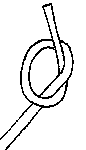 Overhand Knot
\Probably the simplest knot in existence. Usually used as a stopper knot, but
a double overhand is preferable.
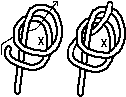 Double Overhand Knot
Better as a stopper knot than the Overhand, as it is less likely to pull
through.
Loops
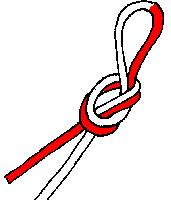 Overhand Loop
This is the simplest way to create a closed loop in the middle of a rope.
Difficult to untie after loading.
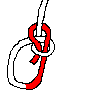
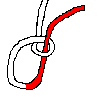 Bowline
The bowline is easy to adjust and untie. Beware, though, that if tied
incorrectly in can be unsafe. You should really tie a stopper knot in the
loop with the loose end to prevent it from pulling through. During heavy
loading, there is a rule of thumb which states that the loose end should be
as long as 12 times the circumference for the sake of safety.
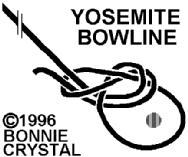 Yosemite Bowline
This is a variant of the basic bowline which gets around the problem of the
knot loosening itself by taking the end of the rope and threading it back
through the knot. This is a neat alternative to using a half-hitch to secure
the end of the rope and the resulting knot has the strength of a figure of
eight.
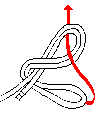
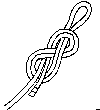 Figure-of-Eight
The Figure-of-Eight knot is probably the most useful of all climbing knots.
It is easy to tie, easy to undo after a load has been applied, and puts the
least stress on the rope when tied tight. It can be tied anywhere in the
rope, but if it's near the end, it should be secured with a stopper knot to
prevent the knot from un-doing itself.
There are generally two methods used to tie a figure of eight knot. The first
method is used when a piece of equipment is clipped into the loop, the second
when the knot is used to tie into something, for example, a climbing harness.
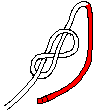
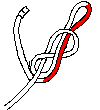
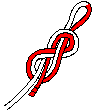 Figure-of-Eight Re-Threaded
The above re-threaded method is usually used to tie into a harness, and is
just a case of making a figure-of-eight on the single rope, looping through
the harness, and following the knot back through itself.
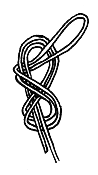 Figure-of-Nine
The figure-of-nine knot can be used as an alternative to the figure-of-eight.
It is very similar to a figure-of-eight with just an extra turn before
finishing the knot. It is a little bulkier than the figure-of-eight but has
greater strength.
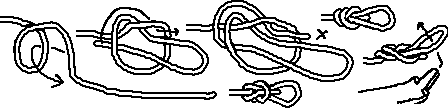 The Bowstring Knot
The Bowstring Knot is an ancient knot that is used as an eye for bowstrings.
The knot is simple and strong. Once tied and pulled firmly, you do not want
to untie it: you might call it a good 'tie-once' loop knot. The bowstring
knot is appreciated because it is small, strong, secure, and easy to tie.
It's neat because it does not have loose ends. If the loose (cross marked)
end is not secured within the loop between the bow and loop, it is wise to
add a small overhand knot as stopper.
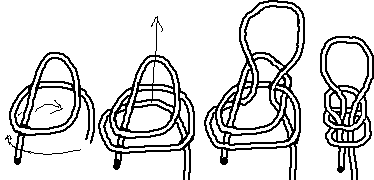 The Strangle-Snare
The strangle-knot is an excellent knot to be used a running knot for a snare.
The pull is easy adjustable. The more force is applied from inside the loop
the more firmly the running knot prevents opening of the loop.
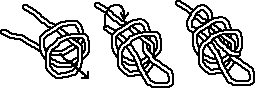 The Tucked Double Overhand
The tucked double overhand is very similar to the bowstring and the strangle
snare knots. They are easy to learn together.
If you need a good looking and strong loop this is a good candidate. The
Loose end must be at least two to three rope diameters long. But if you make
the loose end inflexible with for instance glue, resch or by melting and you
can hide it almost completely inside the two round turns. The "tucked double
overhand" is a permanent loop. It jams badly, but that´s what it is made for.
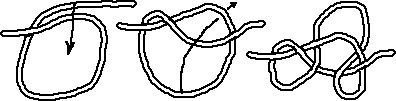
 Alpine Butterfly
A good knot for rebelays or for tying rub points out of a rope. Its main
advantage is that the two strands of rope emerging from the knot are at 180
degrees to one another rather than emerging in the same direction as in a
figure-of-eight for example. This makes it a good mid-rope knot and good for
rebelays because it has greater strength than a figure-of-eight if the
rebelay fails.
 The Artillery Loop
A practical and easy to tie loop for applications needing a loop in another
place than the rope-end but somewhere in the middle. It is not as strong as
the butterfly but is a bit faster to tie and untie. As the name already
suggests it was used by the artillery (for carrying their guns over the
shoulder.) Do not pull the rope too hard when the loop is not loaded. It is
best used as temporary knot for carrying things. As always, work up the knot
neatly.
Bends
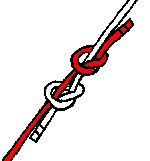 Fisherman's Knot
Probably the simplest knot for joining two ends of rope. Consists of two
overhand knots.
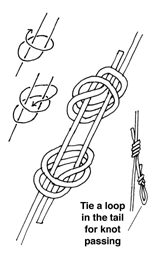 Double Fisherman's Knot
Better than the Fisherman's Knot, this uses two double overhand knots. Good
knot, as it can be difficult to untie. Check regularly for the loose ends
getting shorter, and if so, re-tie. Tighten with body weight.
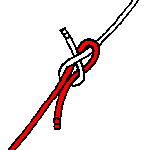 Sheet Bend
Occasionaly used to join the ends of ropes, may be adjusted easily, but can
also come undone easily.
Hitches
 Tautline Hitch
This knot is the standard for tying out tents in rough weather. This knot
will slip up and down the rope by hand, but not by tention. You can also fix
a draw-string sack with this knot.
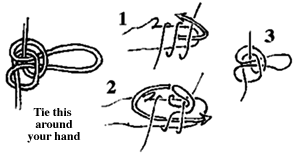
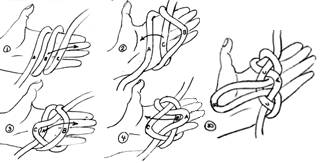 Farmers hitch
This knot is excellent for tying in the middle of a climbing rope, for
rebelays, for lashings of many kinds - anyplace a loop that leads fair both
ways in wanted. The method for putting it in is simplicity itself:
- Take three turns of the rope round your hand, then:
- Move center part (b) over right part.
- Move new center part (c) over left part.
- Move new center part (a) over right part.
- Pull new center part (b) up to form the loop
- For most satisfying results, remove hand before fairing or loading knot.
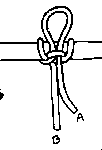
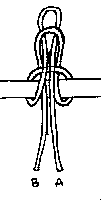
 Highwayman's Hitch
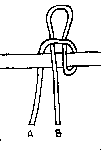
This knot can bear one's weight on one strand of the rope and can be untied
by just pulling on the other strand. End 'B' is the load-bearing end. NOT
RECOMMENDED for climbing, but excellent for robbing stagecoaches, when you
want to get away quick with your rope.
 Girth Hitch/Lark's Foot
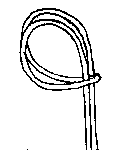
Quick knot, but weak. Best avoided.
 Constrictor Hitch
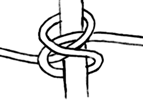
A new knot useful to cavers and climbers was invented early this century
by Clarence Ashley himself. He calls it "the constrictor knot". It is
enormously resistant to coming undone. Ashley claims it can be used in a
pinch as a radiator hose-clamp.
 Italian/Munter Hitch
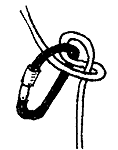
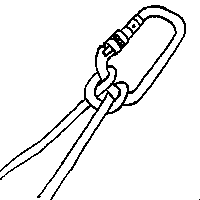
An excellent self-reversing friction knot suitable for belaying people when
climbing or using a ladder. It can also be used for abseiling and gives a
smoother ride than a stitcht plate (IMHO).
This one is worth learning for all those occasions when you forget your
Stitcht plate or descender.
 Clove Hitch
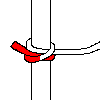
The clove hitch is easily adjusted when place, but is not a particularly
strong knot. If one side of the knot is to be loaded, place the diagonal
underneath. If both sides are to be loaded, place the diagonal at the top.
Tighten before loading, as it may run if loaded when loose.
Miscellaneous Knots
 Bowline on the bight
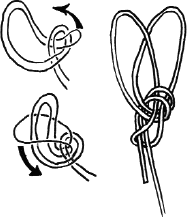
This is another double loop knot suitable for rigging Y-belays. It has the
advantage that is is a bit less bulky than the figure-of-eight on the bight.
 Double Figure-of-Eight on the Bight
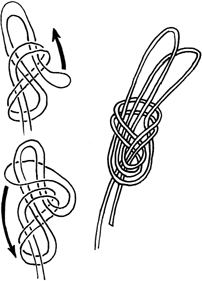
This double loop knot is most commonly used for rigging Y-belays. The nature
of the knot means that it is reasonably easy to adjust the loops by moving
rope from one of the loops to the other.
Ascending Knots
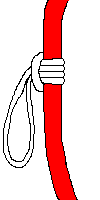 Prusik Loop
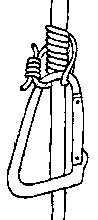
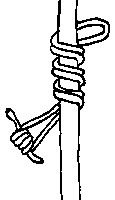
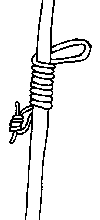 The French Prusik
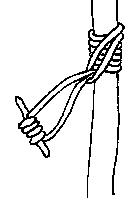
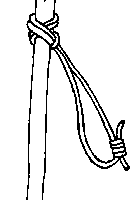
 The Kleimheist
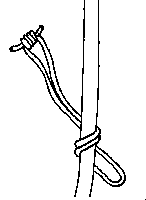 The Hedden Knot, also known as Kreutzklem
First published in 1960 in Summit Magazine. In 1964, the name Kreutzklem was
attached to it by someone in the German mountain troops who was shown it by
an officer serving in the US Air Force. The Kreutzklem name (cross-clamp) was
applied because the original inventor (Chet Hedden) got lost somewhere along
the way when it was shown to different people in Europe.
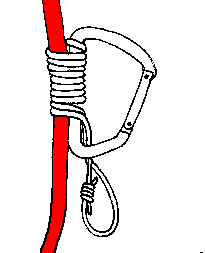 The Bachmann