Canoeing Basics
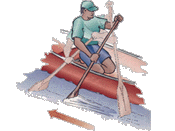 Basic Power Stroke: An efficient forward power stroke can propel
your canoe for hours without killing your back. Most people work too hard
at this. To make a forward stoke (right-handed), rotate your upper body
slightly to the left and lean forward as your bring the paddle forward.
Bury the paddle blade in the water, and let your upper body rotate back
to the right as you draw the paddle back toward your hip in a straight
line parallel to the side of the canoe.
Basic Power Stroke: An efficient forward power stroke can propel
your canoe for hours without killing your back. Most people work too hard
at this. To make a forward stoke (right-handed), rotate your upper body
slightly to the left and lean forward as your bring the paddle forward.
Bury the paddle blade in the water, and let your upper body rotate back
to the right as you draw the paddle back toward your hip in a straight
line parallel to the side of the canoe.
By the time the paddle is past your hip, the power stroke is over. If you
apply power beyond that point, when the paddle starts coming up at a
rearward angle, you'll be lifting water instead of pushing the canoe.
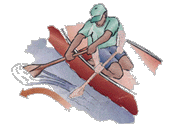 J-Stroke: When paddling solo, each repeated power stroke will turn
the canoe slightly to the opposite side. That's when you need a J-Stroke
for correcting your course to a straight line. It's basically a power stroke
with a curved tail. The stroke looks like a reversed capital letter J when
viewed from above (if your're paddling on the right side of the canoe), which
may help you visualize the process.
J-Stroke: When paddling solo, each repeated power stroke will turn
the canoe slightly to the opposite side. That's when you need a J-Stroke
for correcting your course to a straight line. It's basically a power stroke
with a curved tail. The stroke looks like a reversed capital letter J when
viewed from above (if your're paddling on the right side of the canoe), which
may help you visualize the process.
Make a regular forward power stroke. As the paddle goes past your hip, rotate
the paddle 90 degrees away from you so the flat blade is parallel to the
canoe instead of perpendicular to it. Push slightly outward (to the right) at
the same time. This is the curved tail of the letter J and has a rudderlike
effect as it swings the bow of the canoe back onto your desired course.
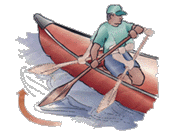 C-Stroke: This is the easiest and fastest way to make a sharp turn.
C-stokes can be done as either forward or backward strokes as needed. Here's
the forward version:
C-Stroke: This is the easiest and fastest way to make a sharp turn.
C-stokes can be done as either forward or backward strokes as needed. Here's
the forward version:
Rotate your upper body and lean forward as if to make a regular forward
power stroke. But instead of coming straight back with the paddle, carve a
broad C-shape away from and then back toward the canoe. This will spin the
canoe around its midpoint, giving you a quick turn.
The most important thing to remember is that most of your power should be
applied in the first, outward portion of the C-stroke. That's where most of
the turning effect is gained.