The First Alabamians
Twelve Thousand years ago or more, primitive hunters followed huge mastodons and ground sloths into Alabama's valleys. The great beasts died out,
but the hunters survived. Slowly, unevenly their descendants built the remarkable
cultures found almost five hundred years ago by the first Europeans.
Paleo Indians (The First Families of Alabama: > 10,000 B.C. to about 7000 B.C.)
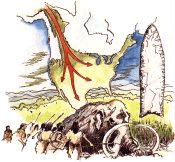 Their ancestors came to America across the land bridge between Alaska and Siberia 20,000 or more years ago. By at least 12,000 years ago, these
hunters had followed game across North America and into the timbered lands that would
become Alabama. Here they sought mastodons, giant bison, and other animals now long
vanished. Never numerous, Paleo Indians roamed in small family bands, living off the
land and hunting the huge beasts whose meat was food and whose skins were clothing and
shelter.
Their ancestors came to America across the land bridge between Alaska and Siberia 20,000 or more years ago. By at least 12,000 years ago, these
hunters had followed game across North America and into the timbered lands that would
become Alabama. Here they sought mastodons, giant bison, and other animals now long
vanished. Never numerous, Paleo Indians roamed in small family bands, living off the
land and hunting the huge beasts whose meat was food and whose skins were clothing and
shelter.
It was life with one primary focus: survival. Today these nomads' distinctive stone spear points and scrapers can be found throughout
Alabama. In the late Paleo period they developed better tools and became more
skillful hunters. At times they camped under the rock overhangs of north Alabama.
Archaic (Hunters and Gatherers: 7000 B.C. to 1000 B.C.)
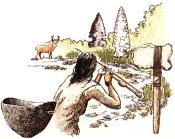 The great beasts did not adapt to climatic changes as the Ice Age ended, but the Indians found other food as their former prey became extinct. Now
they sought smaller game such as deer, turkey, rabbit, and even skunk, fox, and wildcat.
Streams provided fish and mussels. Gathering nuts, berries, roots, and
greens, Archaic Indians developed a varied, healthy diet.
The great beasts did not adapt to climatic changes as the Ice Age ended, but the Indians found other food as their former prey became extinct. Now
they sought smaller game such as deer, turkey, rabbit, and even skunk, fox, and wildcat.
Streams provided fish and mussels. Gathering nuts, berries, roots, and
greens, Archaic Indians developed a varied, healthy diet.
With so much food close at hand they established more permanent camps, returning after seasonal trips to better hunting grounds. Hunters
gained distance and accuracy with the atlatl spear thrower. Craftsmen
fashioned various stone tools and fine stone pots and, later, simple pottery permitted
cooking and storage of food.
Cultures did not advance evenly in all parts of the state. While some groups were still in the Archaic period, others had already taken a
major step into the next phase of development.
Woodland (Crops, Pots, and Burial Mounds: 1000 B.C. to A.D. 800)
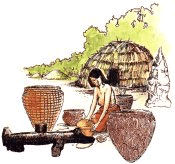 Cultivation began in Alabama when Indians discovered they could grow food at their villages in addition to gathering it in the wild. This more
dependable food supply did away with the need for seasonal migration. While hunting
and fishing remained important, no longer was survival the focus of Indian life.
Cultivation began in Alabama when Indians discovered they could grow food at their villages in addition to gathering it in the wild. This more
dependable food supply did away with the need for seasonal migration. While hunting
and fishing remained important, no longer was survival the focus of Indian life.
Now there was time to develop art and religion. Pottery not only was useful, but it often became an art form as well. Intricate designs
graced beautifully shaped vessels. The Woodland people mastered carving and left
behind both fanciful and lifelike stone effigies of themselves and the animals which
surrounded them. Artists fashioned shells and stones into decorations.
Complex religious rituals introduced the burial mounds which today are seen throughout the state. Trade with other groups brought conch shells
from the Gulf of Mexico and copper from the Great Lakes.
The prosperity of the Woodland Indians ushered in the next and grandest era of Alabama Indian culture.
Mississippian (The Temple Mound Builders: A.D. 800 to A.D. 1500)
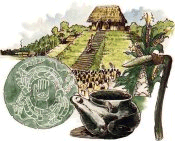 It was a society based on raising corn. Bolstered by extensive trade, the economy supported an art community and great public works.
Mississippians developed elaborate rituals and a complex social structure. Across
the South into the Midwest, they built mounds to support temples and the homes of their
nobles.
It was a society based on raising corn. Bolstered by extensive trade, the economy supported an art community and great public works.
Mississippians developed elaborate rituals and a complex social structure. Across
the South into the Midwest, they built mounds to support temples and the homes of their
nobles.
Skilled artists worked in stone, pottery, bone, and copper to achieve beautifully formed and decorated objects. The society was structured with
classes of priests, nobles, warriors, craftsmen, and workers.
Three thousand people once lived at today's Mound State Monument also known as Moundville Archaeological Park.
For 500 years no city in the southeast again reached that size. Here some 20 mounds, protected by a palisade, overlooked the river plain. Smaller centers flourished on other rivers. Satellite villages grew up along the streams for many miles around these major religious and market centers.
Archaeology at Mound State Monument shows no contact with the white man. A sophisticated culture had flourished and then mysteriously declined.
Alabama Indians and The Europeans
Spanish sailors peeked into Mobile Bay in 1519, but in 1540 Hernando De Soto's army gave Europeans their first looks at today's Alabama. His
army forced its way across 300 miles of Alabama from the northeast corner deep into the
coastal plain and back north on the western side. Somewhere in south Alabama at
Mabila, they fought history's greatest battle between the white and Indian cultures.
De Soto's writers told of independent provinces with walled towns where subjects carried their princess on litters. Wooden houses surrounded
central plazas dominated by temple-crowned artificial mounds.
The Spaniards didn't know they hastened the end of an elaborate culture already in decline. Retreating to the north from Mabila, De Soto
passed without noting what was long the largest city in the southeast, today's Mound State
Monument.
 In a few years other Spaniards found that populations along DeSoto's route rapidly and often mysteriously decreased. Many separate groups
disappeared or were absorbed by others. Probably the independent nations De Soto
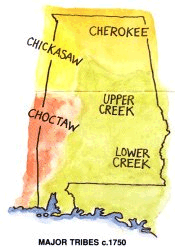
plundered became the Cherokee, Creek, Choctaw, and Chickasaw tribes. Alabama
Indian culture then felt the impact of power struggles among Spain, France, and England.
In the 1700's the French established Mobile and inland trading forts. British
traders from the Colonies pressed deep into Indian nations. Tribes warred among
themselves, allied at times with the European powers.
In a few years other Spaniards found that populations along DeSoto's route rapidly and often mysteriously decreased. Many separate groups
disappeared or were absorbed by others. Probably the independent nations De Soto
plundered became the Cherokee, Creek, Choctaw, and Chickasaw tribes. Alabama
Indian culture then felt the impact of power struggles among Spain, France, and England.
In the 1700's the French established Mobile and inland trading forts. British
traders from the Colonies pressed deep into Indian nations. Tribes warred among
themselves, allied at times with the European powers.
The Revolution replaced ambitious rival Europeans with land-hungry Americans. Treaty after treaty opened large areas in Alabama to whites,
until the Creeks rebelled in 1813. In 1814 Americans under Andrew Jackson and their
Indian allies settled the issue forever at Horseshoe Bend.
Many Indians in Alabama already lived much like white settlers. Farmers and hunters, they often built villages of log houses. As the
Indians adapted to white ways on their remaining lands, they became known as the
"Civilized Tribes." Sequoyah developed his famous Cherokee alphabet while
living in northeast Alabama's Warrior Mountains.
But still they could not stop the tide of expansion. The final push came in 1830's with wholesale removal of most southeastern Indians to lands in Oklahoma, this event has became known as the Trail of Tears.
This above is from a brocure I picked up at the Moundville
Archealogical Park outside of Tuscaloosa Alabama.
The Removal of The Warrior Mountain Indians
For some 12,000 years prior to the early 1800's, the entire
area throughout the Warrior Mountains was inhabited, controlled, and ruled by our
aboriginal ancestors. Through the early European explorations of De Soto in 1540,
other adventurous expeditions/military campaigns, and encroachments by early settlers, our
native people were weakened by the ravages of disease and wars that wiped out entire
villages and towns. The tragic stage for the decimation of our Warrior Mountain
Indian people was finally set after some 275 years of fighting these diseases and wars
brought about by the greed of the European settlers.
The High Town or Ridge Path followed the east-west Continental
Divide through the Warrior Mountains and was occupied home lands of the Chickasaws and
Cherokees around the 1750's. Long before their occupation, the Tennessee Valley was
claimed as hunting territory for both tribes. The southern drainages of the Divide
were occupied by our Creek ancestors when De Soto marched his army through Alabama in
1540. It was the lands in the heart of the Warrior Mountains that Creek people had
called home for hundreds of years.
Finally, our native people began to crumble from the European
onslaught and pressure. The first native lands of the Warrior Mountains were
threatened by the Cotton Gin Treaty of 1806. Later, the Treaty of Fort Jackson in
1814 took all our Creek homelands in the Warrior Mountains, south of the High Town Path.
Within two years, the Turkey Town Treaty of September 16 & 18, 1816, had taken
the last remnants of our aboriginal ancestors' native lands in the Warrior Mountains.
The following years of forced removal decimated our native people, who had lived
for thousands of years in harmony with the land of the Warrior Mountains.
Copyright The Wild Alabama Organization.